Many good managers with great teams struggle due to lack of time, micromanaging (surprise, micromanaging can also be a burden on the one who does it), the unbalanced work-life ratio and the need to always be present and make decisions in every small and big issue.
Well, I have a good news for you. You can become a better leader with a successful team, it would just take you to change your way of looking at the work and your employees and coaching can help you in that shift.
Create more team buy in and feeling of ownership
When a manager is sharing objectives with the team, he literally gives directions and ways of reaching those. When something doesn’t work out – naturally the stuff comes back to the manager and asks for a direction again. You see the pattern, you direct people and follow them closely, they come back to you immediately when something doesn’t work out, without thinking creatively at all. Try using a different approach instead. Invite your team, ask them to collaborate on the objectives, while keeping in mind the overall direction of the business you want to reach. From a psychological point of view, people have a tendency to work with more energy and be more motivated when they are working towards goals they set for themselves. Create a feeling of ownership in your team and benefit from their proactivity.
Try “pull vs push” approach
Who likes to be given tasks? I bet you won’t find such a person, neither do your employees. Instead of coming to them and ordering to do something, give them more space and a creative task to brainstorm: How we as a team can reach those objectives? What will that bring you? The team will use their own skill set to come up with the tasks they will identify and that would create this “pull” approach which you want as a manager and a leader. You will not dump new tasks on your staff, they will come to you and tell: “look, we can do so and so, what’s your opinion on that?” That’s exactly the result you want as a leader – you want to empower your people to become more active and come to you rather than you following them with the tasks and dumping them, after that following it and keeping a close eye if the tasks are being implemented correctly.
Ask your team how they want to be lead
We’ve all seen this picture, where the manager orders to the team where to go and the true leader is the one who pulls the weight and shares it with the team?
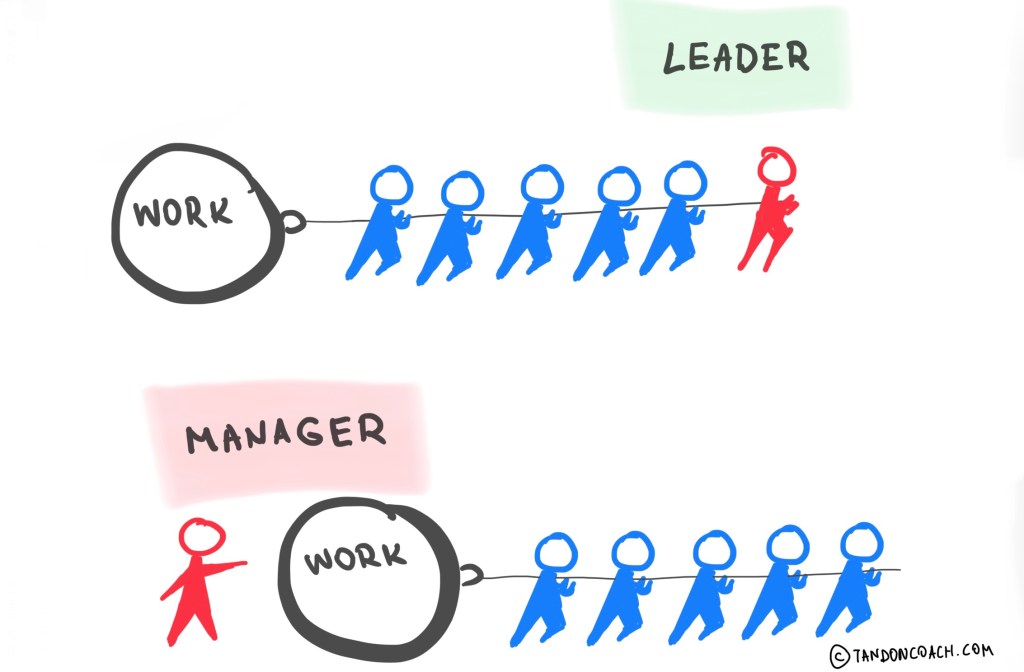
Well, this representation is a bit outdated. Nowadays, you don’t just lead the team your way, you ask them how they want to be lead. They will tell you exactly what they are missing, it’ll become very transparent what they are lacking to achieve better productivity, interactions, reporting and check-ins.
Just last week in my team we’ve been deciding whom to send to a customer. As a scrum master I had one nominee in mind and came to the senior person in the team with this suggestion. And guess what? He immediately stopped me saying: “Why won’t you ask the team?” I love that approach, because he had some valid opinion on my choice and so simply suggested me the best way: ask the team, don’t take the burden on making the decision on yourself. I’m so grateful for my team members being so alerted and so aware about what’s happening, to bring me back on track when I get stressed and get into the anti-pattern of managerial behavior.
And yes, on Monday I’ll make sure to ask the team to decide who’d like to go to the customer’s visit. Such a relief to make one less decision.
Keep regular retrospectives
Many companies use to have a lot of “post-mortem” meetings discussing what went wrong. Try to change the mind and while acknowledging where things went wrong come up with the possible solutions how and where can you act differently. Create a list of what can be done in a similar situation and approach it as a hypotheses. Don’t repeat same scenarios but at the same time don’t get discouraged in the hypotheses didn’t work out. This approach will help the organization to shift an overall mindset from seeing the problems into seeing the solutions.
Be more supportive less authoritarian
Position yourself as a supportive leader with an open door policy vs showing off your authority. If you’ll manage to create an adult partnership with your employees, where you show that you trust them, you’re there if they need your advise and you’re open for a discussion, you’ll be more appreciated by your stuff and become more of a coach and adviser, to whom people would not be afraid to reach out.
I hope you’ll try out the above behaviors if not yet practicing them and if you’ll feel that you are not prospering in these – feel free to reach out to discuss how you can change your behavior to become a better coach and leader to your own team.

 Psychology & Business Coaching
Leave a comment